Key takeaways
- Whitstable's oyster trade is genuinely ancient. The Romans prized north Kent oysters, and the town's Company of Free Fishers and Dredgers was incorporated by Act of Parliament in 1793.
- Native oysters follow the traditional 'R months' custom (roughly September to April), tied to the summer spawning season. Farmed Pacific rock oysters are sold year-round, so there's always something on the ice.
- The festival is now the Whitstable Rocks Oyster Festival, held in September (11–13 September in 2026), not the old July date many guides still list.
- This is a working harbour, not a marina, and a town reshaped by 'DFL' (Down From London) weekenders. That's a more honest and interesting story than 'quaint fishing village'.
- Parking is the real summer headache. The 255-space Gorrell Tank car park is the main central option, but arriving by direct train from London sidesteps it entirely.
On this page
Some towns are pretty. Some are foodie. Whitstable manages both: a working fishing town on the north Kent coast that’s become one of the South East’s most loved places to eat. It’s best known for oysters, and rightly so, but treat it as an oysters-only day out and you’ll miss half of what makes it special. Here’s how to eat your way round Whitstable properly.
Why Whitstable earns its reputation
Whitstable’s oyster trade is genuinely ancient. The Romans prized oysters from the north Kent coast, and the town has dredged its native beds for the best part of two millennia. That heritage isn’t just marketing: the Company of Free Fishers and Dredgers was incorporated by Act of Parliament in 1793, making its successor, the Whitstable Oyster Fishery Company, one of the oldest companies in Europe. The seafront Royal Native Oyster Stores, built in 1893 to sort and pack the catch, still carries the company’s name across its gable.
What Whitstable isn’t is a museum piece. Over the last couple of decades it’s grown into one of the towns that reignited the Kent coast’s food reputation, with delis, bakeries, cafés, pubs and restaurants packed into a walkable stretch between the High Street and the sea. It’s also become a byword for the “DFL” (Down From London) phenomenon: weekenders and second-homers who pushed prices up and reshaped the town. It’s a genuine local tension, and a more honest story than the usual “unspoilt fishing village” line.
Oysters: what to know before you order
The oyster is Whitstable’s signature, so it helps to understand what’s on the ice:
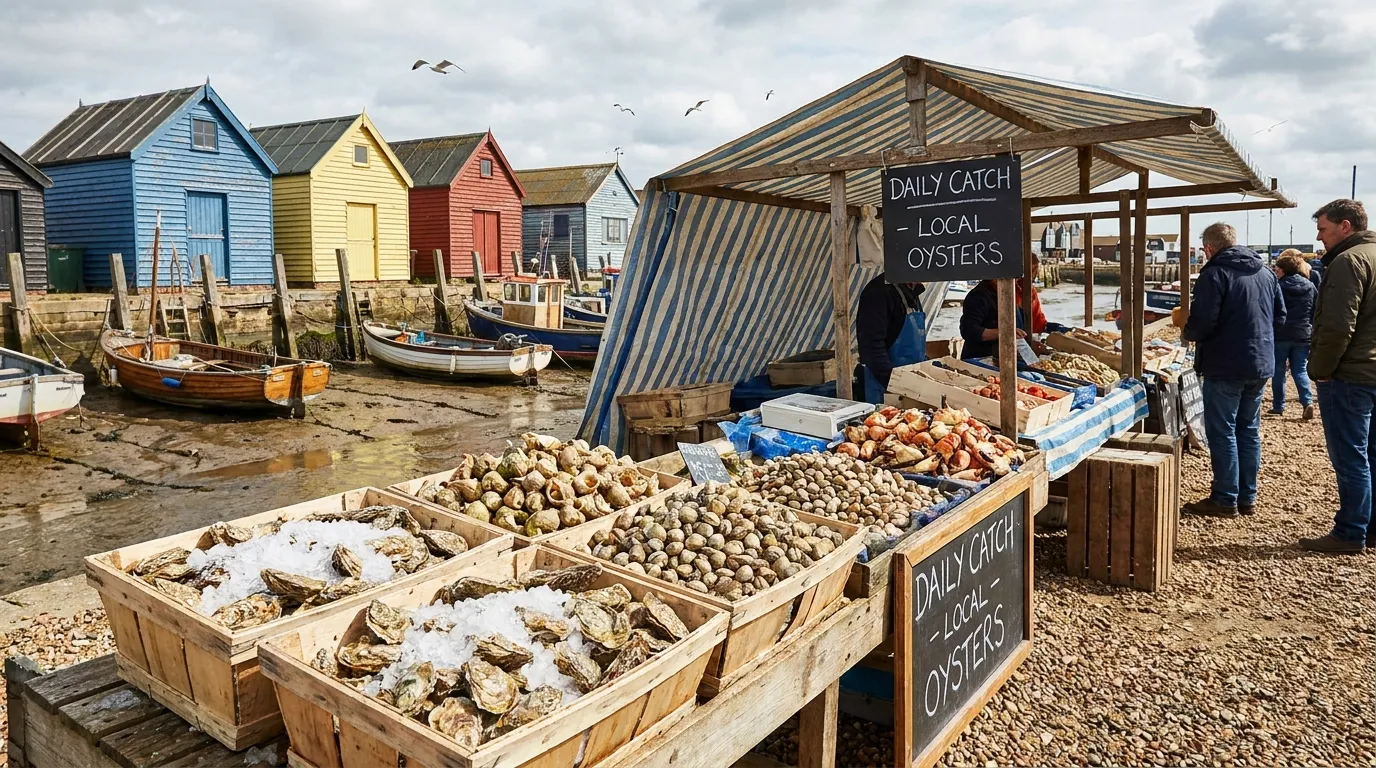
- Native oysters, the prized flat Ostrea edulis, follow the traditional “R months” custom: eaten roughly September to April and left alone over summer when they spawn and turn soft. That’s a centuries-old rule of thumb, backed up by a separate legal close season that protects the wild beds.
- Pacific rock oysters grow faster, are farmed, and are available year-round, which is why you can order oysters here whatever the season.
One honest bit of nuance most guides skip: the wild native fishery collapsed in the mid-20th century. Over-fishing, disease and the brutal 1962–63 winter devastated the beds, so today’s “Whitstable oysters” are largely farmed Pacific rock, with true natives a prized minority. Order a few of each and taste the difference.
The Whitstable Rocks Oyster Festival
The town’s food calendar peaks with the Whitstable Rocks Oyster Festival, and here’s where many guides are out of date. It’s no longer the old late-July event; it now runs in September (11–13 September in 2026), re-formed under new organisers after the original was scaled back. Expect the traditional “Landing of the Oysters” (a ceremony traced back to 1657), plus food stalls around the harbour, music and family events.
One honest caveat: the festival brings the biggest crowds of the year. If you’re coming specifically for it, book restaurants well ahead and read the travel section below. If you’d rather have the town to yourself, a bright weekday outside the festival is a lovely, calmer alternative.
Beyond the oysters
The mistake is stopping at seafood. Whitstable rewards a wander:
- The harbour. A genuine working quay (aggregate ships and fishing boats, not a yacht marina), with a fish market and seafood stalls where the catch comes in.
- The High Street. Independent delis, bakeries and cheesemongers rather than chains, and a good place to assemble a picnic. Wheelers Oyster Bar, established here in 1856, is the town’s oldest eatery and a landmark in its own right.
- The pubs. From harbourside spots to backstreet locals, several with a strong food offer and Kentish ales on tap.
- The fishermen’s huts. The black-tarred former working huts along the shingle, now iconic, tell the story of the town’s shift from fishing to tourism.
Browse reviewed restaurants in Whitstable, pubs in Whitstable and cafés in Whitstable to build your own route round the town before you go.
Make a day of it: the wider north-Kent food trail
Whitstable is even better as part of a bigger food day out:
- Faversham. A historic market town a short hop away, home to Shepherd Neame (Britain’s oldest brewer) and a celebrated farm-shop food hall.
- Herne Bay. Along the coast, with its own seafront cafés and a more low-key seaside feel.
- The Crab & Winkle Way. The walking and cycling route that follows the old Canterbury & Whitstable Railway of 1830, one of the earliest scheduled passenger railways in the world (engineered by the Stephensons). It links Whitstable to Canterbury through the woods, a proper way to earn your lunch.
For provenance-led shopping, Kent’s farm shops and butchers are the places to find local meat, cheese and seasonal veg to take home.
The practical bit: getting there and parking
Whitstable’s one real drawback is a happy problem. It’s popular, and in summer that means parking is tight.
- The Gorrell Tank car park near the centre (around 255 spaces, sat over a Southern Water stormwater tank) is the largest option, but it fills quickly on sunny weekends and festival days.
- Arriving by train lets you skip the parking scramble entirely: direct services run to London Victoria (roughly 1¼–1½ hours), with high-speed options towards St Pancras, and it’s a short walk from the station into town.
- If you do drive, the A299 Thanet Way is the main road in, so come early and have a backup plan for the car.
How to do Whitstable well
Put it together and the ideal Whitstable food day looks like this: arrive by train or early by car, graze the harbour and High Street, sit down for oysters (natives in the colder months, rock in summer), and leave time for a deli stop before you go. Add Faversham’s farm shops, or the Crab & Winkle walk, if you’ve got the day.
Ready to plan? Browse reviewed restaurants, pubs and cafés in Whitstable and along the Kent coast, book ahead for weekends and the September festival, and go hungry.
Frequently asked questions
When can you eat Whitstable oysters?
Native oysters (the prized flat Ostrea edulis) follow the traditional 'R months' custom: eaten roughly September to April and avoided over summer, when they spawn and turn soft and milky. That's a centuries-old rule of thumb rather than a food-safety law, though a separate statutory close season also protects the wild native beds over the summer. Farmed Pacific rock oysters mature faster and are sold all year, so you can eat oysters in Whitstable in any season. It's the type that changes, not the availability.
When is the Whitstable Oyster Festival?
It now runs as the Whitstable Rocks Oyster Festival in September (11–13 September in 2026), after the original late-July festival was scaled back and re-formed under new organisers. The traditional 'Landing of the Oysters', a ceremony traced back to 1657, survives as part of it. It's the town's food highlight but also its busiest weekend, so book ahead and plan your travel carefully.
Is there more to Whitstable's food scene than oysters?
Yes. Oysters are the headline, but Whitstable is a genuinely walkable food town: a working fish market at the harbour, seafood restaurants along the seafront (some in listed oyster-trade buildings), independent delis, bakeries and cafés up the High Street, and pubs pouring Kentish ales. Wheelers Oyster Bar on the High Street, established in 1856, is the town's oldest eatery and a heritage landmark in its own right.
How do I get to Whitstable and where do I park?
Whitstable has direct trains to London Victoria (roughly an hour and a quarter to an hour and a half) plus high-speed services towards St Pancras, and sits just off the A299 Thanet Way. Parking is the main headache in summer. The Gorrell Tank car park near the centre (around 255 spaces, built over a Southern Water stormwater tank) is the largest, but it fills fast on sunny weekends and festival days. Arriving by train and walking in is usually the least stressful option.
What else is worth visiting nearby?
Whitstable pairs well with the rest of north Kent's food scene. Faversham, a short hop away, is a historic market town with Britain's oldest brewer, Shepherd Neame, and a celebrated farm-shop food hall. Herne Bay along the coast offers a more low-key seaside feel, and Canterbury is a short ride inland. You can even walk or cycle part of the old Crab & Winkle Way between Whitstable and Canterbury.
Find a trusted Kent business
Browse reviewed local listings by category and town across the county.
Search the directory