
Key takeaways
- Much of Kent sits on shrinkable Weald and London clay. The British Geological Survey rates the area among England's most subsidence-prone, so foundations matter more here than the national average.
- Around a third of the county is protected landscape (the Kent Downs and High Weald National Landscapes), on top of 500+ conservation areas and 17,000+ listed buildings, all of which cut back what you can build without permission.
- Kent's period homes (oasts, weatherboard, ragstone, peg-tile roofs) need a builder who works in lime, not cement. The wrong materials cause real structural damage.
- Unauthorised work to a listed building is a criminal offence, and the builder can be prosecuted alongside the owner, so heritage experience is protection, not a luxury.
- Get three written quotes, check insurance and accreditations (FMB, TrustMark, Gas Safe, Part P), and sort Party Wall notices early on Kent's many Victorian terraces.
On this page
Hiring the right builder is the difference between a project you enjoy and one you’d rather forget. But choosing one in Kent comes with a few local wrinkles that generic advice misses: the ground moves more than most people realise, a surprising amount of the county is protected, and a huge share of its housing is exactly the kind of period property that punishes a one-size-fits-all approach. Here’s how to choose well.
Why choosing a builder in Kent is a bit different
Three things set Kent apart. First, its geology: much of the county sits on clay that swells and shrinks with the seasons. Second, its landscape protections: roughly a third of Kent is a designated National Landscape. And third, its building stock: Kent has more than 17,000 listed buildings and over 500 conservation areas, plus a distinctive vernacular of oasts, weatherboard and ragstone. A builder who knows all three is worth their weight in gold.
Kent ground can move: clay, chalk and foundations
The single most important technical point: the British Geological Survey rates Kent among the parts of Britain most susceptible to clay shrink-swell subsidence.
- Weald Clay underlies the Low Weald: think Tonbridge, Paddock Wood, Staplehurst and the Cranbrook area towards Ashford. It’s one of the country’s most damaging shrink-swell formations.
- London Clay covers north Kent (the Medway and Thames marshes, the Isle of Sheppey, Herne Bay and Whitstable) and is another classic subsidence soil.
- Chalk of the North Downs (Dartford through to Canterbury, Deal and Dover) is generally a good foundation, except where dissolution features or “swallow holes” cause differential settlement.
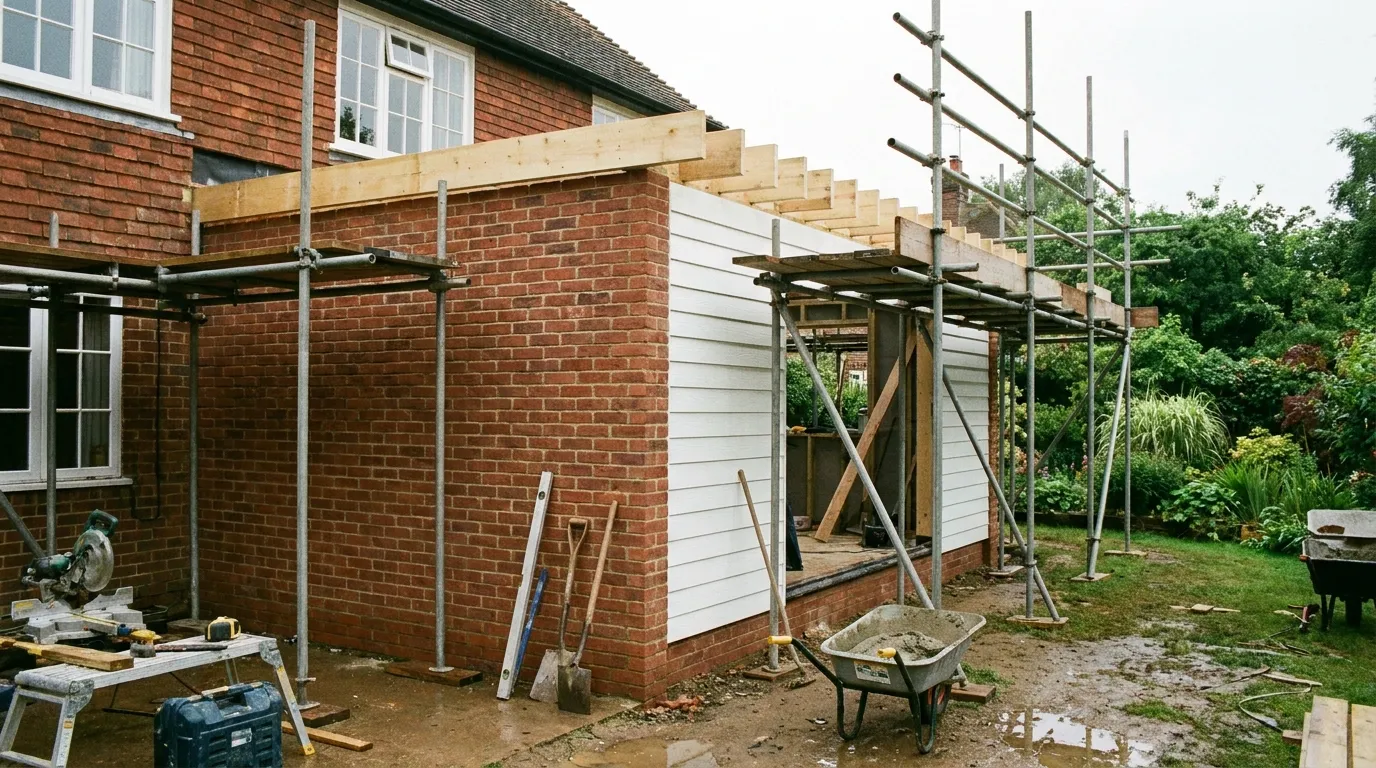
Why it matters: on shrinkable clay, especially near mature trees, foundations frequently have to go far deeper than a simple strip footing, sometimes 1.5 to 3 metres or more, with extra heave precautions. That’s a real cost difference, and it’s why a good Kent builder will recommend a site-specific soil or trial-hole investigation rather than quoting a fixed foundation price sight unseen. If a quote skips this entirely, be wary.
Planning is stricter across much of Kent
Kent is unusually constrained, so don’t assume your project falls under permitted development.
- The Kent Downs and High Weald National Landscapes (formerly AONBs) together cover around a third of the county. In these areas, permitted development rights are cut back: side extensions and outbuildings are restricted, and modest works can need full planning permission.
- In conservation areas, you’ll need permission to demolish, and there are tighter controls on alterations and even on trees.
- An Article 4 Direction can remove normal permitted-development rights street by street. Faversham has one of the largest in Kent, covering replacement windows, doors and roofs on principal elevations.
- Listed building consent is separate from planning permission and covers internal works too.
Planning is handled by Kent’s twelve district and borough councils (Tunbridge Wells, Maidstone, Canterbury, Ashford, Swale, Tonbridge & Malling, Sevenoaks and the rest), not by Kent County Council. Remember too that planning permission and Building Regulations approval are two different things; many projects need both. For Building Regs you can use either council building control or a registered private approver.
Period and vernacular properties need a specialist
Kent’s older housing is part of its charm and a genuine technical challenge. If your home is period or built in a local vernacular, hire accordingly:
- Oast houses and timber-framed Wealden hall houses were built to breathe. Modern cement render and hard mortars trap moisture and can cause serious structural decay, so these need lime-based, breathable methods.
- Kentish weatherboard needs regular recoating and character-matching repair.
- Kentish ragstone is a hard, unpredictable stone that breaks awkwardly and wants specialist masons and lime mortar.
- Flintwork is officially an endangered craft, with very few people working it full-time; it’s a specialist skill, not a general-builder job.
- Kent peg tiles usually fail at the fixings before the tiles themselves; a good roofer matches type, colour and size and beds them properly, which is why reclaimed tiles are in demand.
The common thread: on old buildings, the right builder reaches for lime, not cement. Ask directly about their experience with your property type.
Checks and accreditations that actually matter
Once you’ve got the local context, the universal checks still apply:
- Public liability insurance. Expect at least £2m of cover; ask to see it.
- Accreditation. The Federation of Master Builders (FMB) vets members and inspects their work; TrustMark is the Government-Endorsed Quality Scheme and is often required for grant-funded work.
- Trade-specific registration. Any gas work must be done by a Gas Safe registered engineer (ask for the ID card), and notifiable electrical work needs a Part P competent-person scheme member.
- A written contract. For an extension, the plain-English JCT Building Contract for a Home Owner/Occupier fixes price, schedule, variations and dispute resolution.
- Party Wall notices. Kent’s towns are full of Victorian terraces and semis (Margate, Chatham, Tunbridge Wells). Work on a shared wall, a new boundary wall or nearby excavation triggers the Party Wall etc. Act 1996, with one to two months’ notice. Starting without it can land you with an injunction.
Building your shortlist
Don’t hire the first name you find. Aim for three written quotes so you can compare scope and approach, not just price, and lean towards builders who work regularly in your area and know the local ground, planners and suppliers.
Browse reviewed builders in Kent by town to start your shortlist (for example builders in Tonbridge or builders in Maidstone) and ask each one the questions above. A good builder will welcome them.
Frequently asked questions
Do I need planning permission for an extension in Kent?
Often, yes, and more often than in many counties. Around a third of Kent lies within the Kent Downs or High Weald National Landscapes, where permitted development rights are reduced, and there are 500+ conservation areas. Listed buildings need separate listed building consent. Always check with your district or borough council before starting.
Why does ground type matter so much for Kent foundations?
Large parts of Kent sit on shrinkable Weald Clay and London Clay, which swell and shrink with moisture. The British Geological Survey rates the region among the most susceptible to clay-related subsidence in Britain, and foundations near trees often have to go significantly deeper, which adds cost. A good local builder will recommend a site-specific soil investigation rather than quoting blind.
What should I check before hiring a builder?
Proof of public liability insurance, recent local work you can actually look at or a past client you can speak to, relevant accreditations (FMB or TrustMark for builders, Gas Safe for gas work, a Part P scheme for electrics), a clear written contract, and, for terraced or semi-detached homes, that they'll serve the right Party Wall notices.
How much does a single-storey extension cost in Kent?
As a rough guide at the time of writing, the South East runs at around £2,300–£3,400 per square metre, plus VAT and fees, higher than the national average. Treat any figure as indicative only and get three detailed written quotes.
Can a builder work on a listed building?
Only with listed building consent, which covers internal as well as external changes that affect character. Carrying out unauthorised work is a strict-liability criminal offence, and the contractor can be prosecuted as well as the owner, so only use someone with genuine heritage experience.
Find a trusted Kent business
Browse reviewed local listings by category and town across the county.
Search the directory